JLG Boom Lift Operators Manual: A Comprehensive Guide
JLG Industries, a leading access equipment innovator since 1969, provides comprehensive support throughout your fleet’s lifecycle. This manual details operation, safety, and maintenance for JLG boom lifts, including the 1100SB model, adhering to ANSI standards.
JLG Industries has been a pioneering force in the access equipment industry since 1969, consistently delivering customer-focused innovations. JLG boom lifts are engineered to provide safe and efficient access to elevated work areas across diverse industries, including construction, maintenance, and manufacturing. These versatile machines offer exceptional reach, flexibility, and stability, enabling workers to perform tasks at significant heights with confidence.
This operator’s manual serves as a critical resource for anyone operating a JLG boom lift. It provides detailed instructions on safe operation, pre-operational inspections, and emergency procedures. Understanding the principles outlined within this guide is paramount to preventing accidents and ensuring the longevity of the equipment; JLG prioritizes operator safety and offers extensive training resources alongside its product line.
Whether you’re utilizing a telescopic, articulating, or knuckle boom lift, this manual will equip you with the knowledge to maximize productivity while adhering to stringent safety protocols. Remember to always consult the specific manual for your JLG model, such as the 1100SB, for detailed specifications and operational guidelines.
Understanding JLG Lift Models
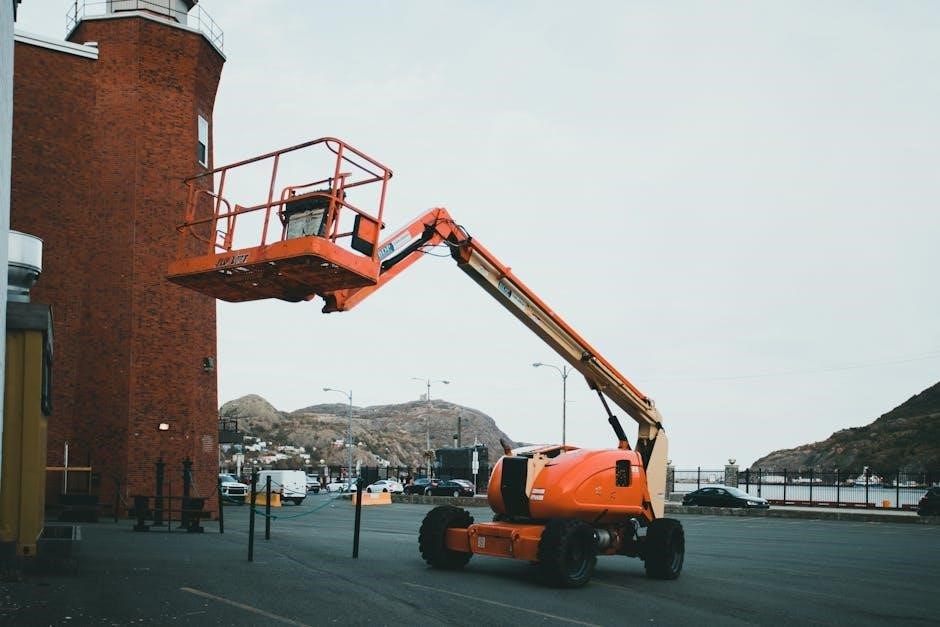
JLG offers a diverse portfolio of boom lifts, each designed to address specific operational needs. Key distinctions lie in boom type – telescopic, articulating, and knuckle – influencing reach, maneuverability, and application suitability. Telescopic booms excel in horizontal reach and lifting capacity, ideal for covering large areas. Articulating booms provide enhanced versatility, navigating obstacles with multiple pivot points.
Knuckle booms, also known as towable boom lifts, offer compact size and portability, suitable for indoor or confined spaces. Within each type, JLG provides varying platform heights and load capacities. The 1100SB, for example, is a specific model with unique characteristics detailed in its dedicated manual.
Understanding these model variations is crucial for selecting the appropriate lift for the task. Always refer to the specific JLG manual for your machine to familiarize yourself with its capabilities, limitations, and safety features. JLG Technical Publications provide comprehensive resources, including schematics and parts lists, to support informed decision-making and efficient maintenance.
Safety Precautions for JLG Boom Lift Operation
Prioritizing safety is paramount when operating a JLG boom lift. Always read and understand the operation and safety manual before use – it contains critical instructions. Conduct a thorough pre-operational inspection, verifying all systems function correctly. Wear appropriate Personal Protective Equipment (PPE), including hard hats, safety glasses, and fall protection harnesses.
Maintain a safe distance from overhead power lines and other obstructions. Be aware of surrounding personnel and potential hazards on the ground. Never exceed the platform’s load capacity, and distribute weight evenly. Avoid operating the lift in high winds or inclement weather.
Ensure the work area is level and stable before elevating the platform. Do not modify or disable any safety devices. Familiarize yourself with emergency lowering procedures. Adherence to ANSI standards is crucial for safe operation. Remember, responsible operation protects both the operator and those around them, ensuring a productive and secure work environment.
Pre-Operational Inspection Checklist
Before each use, a comprehensive pre-operational inspection is vital for safe JLG boom lift operation. Begin with a visual check for any damage, leaks, or missing parts. Inspect the tires for proper inflation and wear. Verify the hydraulic system for leaks and proper fluid levels.
Test all machine controls, including emergency stop, drive functions, and boom movements, ensuring responsive operation. Check the platform for secure attachment and proper functioning of guardrails. Examine the fall protection system, including harnesses and lanyards, for damage or wear.
Confirm the battery is fully charged and the engine (if applicable) has sufficient fuel and oil. Inspect all safety decals and ensure they are legible and securely attached. Document any discrepancies and address them before operation. A thorough checklist, as outlined in the manual, guarantees a safe and productive workday, minimizing potential risks and maximizing equipment reliability.
Machine Controls and Indicators
The JLG boom lift’s control panel is intuitively designed for safe and efficient operation. Familiarize yourself with all controls before use, referencing the manual for specific model details. Key controls include the drive levers, boom elevation and rotation controls, and platform rotation functions.
Essential indicators provide crucial information about the machine’s status. The hour meter tracks operation time for maintenance scheduling. The fuel gauge (if applicable) displays remaining fuel levels. Hydraulic oil temperature and pressure gauges monitor system health. Warning lights alert the operator to potential issues, such as low battery or excessive tilt.
Understand the function of the emergency stop button, which immediately halts all machine movements. The manual details the location and operation of all controls and indicators, ensuring operators can effectively monitor and manage the lift’s performance, promoting safety and preventing damage.
Operational Procedures: Basic Movements
Prior to commencing any movement, ensure the area is clear of obstructions and personnel. Initiate drive functions using the side-by-side drive levers, moving slowly and deliberately. Steering is achieved by gently pushing the levers in the desired direction. Always maintain a stable base and avoid abrupt turns.
Boom elevation is controlled via dedicated levers or buttons, raising and lowering the boom smoothly. Rotation of the boom is managed through another control, allowing for precise positioning. Platform rotation enables adjustments within the work area without repositioning the entire machine.
Remember to operate within the machine’s limitations, as outlined in the capacity charts. Avoid raising the boom above horizontal with a load, as this can compromise stability. Refer to the JLG manual for detailed instructions and safety precautions regarding basic movements, ensuring safe and efficient operation;
Operational Procedures: Advanced Maneuvers
Advanced maneuvers with a JLG boom lift require heightened awareness and precision. Utilize the simultaneous movement controls cautiously, coordinating boom elevation, rotation, and platform movement for complex positioning. Practice these maneuvers in a controlled environment before undertaking tasks at height.
When navigating tight spaces, employ the machine’s oscillating axle feature (if equipped) to maintain stability. Carefully assess ground conditions before attempting maneuvers on slopes or uneven terrain. Avoid sudden stops or changes in direction, which can destabilize the lift.
Remember to always prioritize safety and adhere to the guidelines outlined in the JLG manual. Understanding boom operating characteristics and limitations is crucial for executing advanced maneuvers safely and efficiently. Proper training and experience are essential for mastering these techniques.
Boom Operating Characteristics and Limitations
JLG boom lifts exhibit specific operating characteristics that operators must understand. Raising the boom above horizontal, even without a load, significantly reduces platform capacity and stability. Always consult the capacity chart for precise load limits at various angles and extensions.
Wind conditions drastically affect boom lift stability. Operators must adhere to wind speed limitations specified in the manual, reducing platform height or lowering the boom in gusty conditions. Uneven ground or excessive slope angles also diminish stability and capacity.
Be aware of the lift’s reach limitations and avoid attempting to extend beyond its maximum range. Overloading the platform or exceeding the boom’s angle limits can lead to tipping or structural damage. Prioritize safe operation by respecting these inherent limitations, as detailed in the JLG manual.
Capacity Charts and Load Limits
JLG boom lifts feature detailed capacity charts crucial for safe operation. These charts, found within the operator’s manual, illustrate the maximum permissible weight in the platform based on boom angle, extension length, and lift height. Understanding these charts is paramount to preventing overloading and potential instability.
Load limits decrease as the boom is raised and extended. Charts specify reduced capacities when operating above horizontal, emphasizing the importance of careful planning. Always account for the weight of all personnel, tools, and materials within the platform.
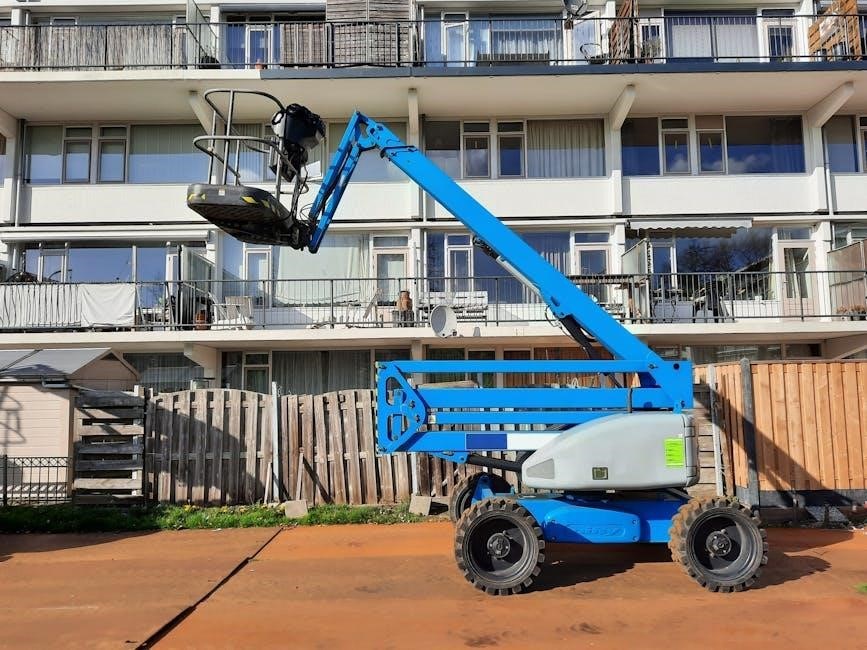
JLG provides specific charts for each lift model, like the 1100SB, ensuring accurate load calculations. Ignoring these limits can compromise stability and lead to serious accidents. Regularly review the capacity chart before each use and adhere strictly to the specified weight restrictions for safe boom lift operation.
Working at Height Safely with JLG Lifts
JLG prioritizes safety when operating at height. This manual emphasizes the necessity of proper fall protection, including the consistent use of full-body harnesses and lanyards secured to designated anchor points. Before each use, inspect all safety equipment for damage or wear.
Maintain a safe distance from overhead obstructions like power lines and structures. Be aware of wind conditions, as strong gusts can affect lift stability. Never exceed the platform’s capacity limits, and distribute weight evenly to maintain balance.
JLG lifts are designed with safety in mind, but responsible operation is crucial. Ensure all personnel in the platform are properly trained and understand emergency procedures. Regular inspections, adherence to ANSI standards, and a commitment to safe practices are essential for preventing accidents while working at height with JLG equipment.
Emergency Procedures and Troubleshooting
This section of the JLG boom lift operator’s manual details critical emergency procedures. In the event of a power failure, understand the manual descent system’s operation – practice locating and using it. If the lift becomes unstable, immediately lower the boom and platform.
For troubleshooting, refer to the diagnostic charts within this manual. Common issues like hydraulic failures or control malfunctions are addressed with step-by-step guidance. Always prioritize safety; if unable to resolve an issue, cease operation and contact a qualified JLG service technician.
JLG Service Centers offer expert repair and maintenance. Remember to document all troubleshooting attempts and report any recurring problems. Familiarize yourself with the location of emergency shut-off switches and ensure they are accessible. Regular maintenance, as outlined in the manual, minimizes potential emergencies.
Maintenance Schedule and Requirements
Consistent maintenance, as detailed in this JLG boom lift operator’s manual, is crucial for safe and reliable operation. JLG recommends a tiered schedule: daily, 90-day, and annual inspections. Daily checks include fluid levels, tire condition, and visual inspection for damage.
The 90-day inspection requires a more thorough examination of hydraulic systems, structural components, and safety devices. Annual inspections, best performed by certified JLG technicians at JLG Service Centers, involve comprehensive testing and component replacement as needed.
Proper lubrication is vital; use only JLG-approved lubricants. Keep detailed maintenance records, noting all inspections, repairs, and parts replacements. Adhering to this schedule extends the lift’s lifespan and ensures compliance with ANSI standards. Neglecting maintenance voids warranties and compromises safety.
JLG Service Centers and Support
JLG Industries maintains a strategically located network of JLG Service Centers to provide expert maintenance and repair services for your boom lift. These centers employ highly-trained technicians utilizing the latest diagnostic tools, ensuring efficient and accurate repairs. Finding a service location is easy – search by city, state, or zip code on the JLG website, or use your current location for nearby options.
Beyond physical locations, JLG offers comprehensive technical support. Access operation, service, and supplemental manuals, schematics, and forms through JLG Technical Publications via OnlineExpress. This resource simplifies parts ordering and troubleshooting.
JLG supports its equipment throughout its entire lifecycle, offering parts, services, and expertise. Promptly addressing maintenance needs through authorized JLG channels guarantees quality repairs and preserves your lift’s performance and safety, adhering to industry standards.
Locating JLG Manuals and Technical Publications
Accessing the correct documentation is crucial for safe and efficient JLG boom lift operation and maintenance. JLG provides a centralized resource for all technical publications through JLG Technical Publications, accessible via OnlineExpress. This platform allows users to easily locate operation manuals, service manuals, and supplemental documentation, including schematics and essential forms.
These publications cover a wide range of JLG lift models, including specific models like the 1100SB (documented as of July 7, 2010, with part number 3121264). Ensuring you have the original instructions, as stated in the manual itself, is paramount for safe usage.
JLG’s commitment to readily available technical information empowers operators and technicians to perform maintenance, troubleshoot issues, and understand boom operating characteristics and limitations effectively, promoting safety and maximizing equipment uptime.
Decals and Safety Signage on JLG Lifts
JLG boom lifts are equipped with a comprehensive system of decals and safety signage, vital for safe operation and adherence to industry standards. These markings provide critical information regarding capacity limits, boom operating characteristics, and potential hazards. Understanding these visual cues is a fundamental aspect of operator training and responsible equipment use.
Specific decals, identified by part numbers like 07690100 (Decal, JLG Lift ‒ C4) and 07691500 (Decal, JLG ‒ C5), clearly communicate essential safety instructions. These include warnings about raising the boom above horizontal, even without a load in the platform, a crucial limitation detailed in section 3-12 of the operation manual (3121703).
Regular inspection of these decals is essential to ensure they remain legible and securely affixed. Damaged or missing signage must be replaced immediately to maintain a safe operating environment and comply with ANSI regulations, as outlined in the JLG boom lift operators manual.
Understanding ANSI Standards for Boom Lifts
JLG boom lifts are designed and manufactured to meet or exceed stringent American National Standards Institute (ANSI) standards for mobile elevated work platforms. These standards, crucial for operator safety and regulatory compliance, dictate requirements for stability, structural integrity, and operational features. The JLG boom lift operators manual emphasizes adherence to these guidelines.
ANSI standards cover a wide range of aspects, including load capacity, emergency controls, and guardrail systems. The manual, designated as providing “Original Instructions,” stresses the importance of keeping it with the machine at all times for reference. Understanding these standards is paramount for preventing accidents and ensuring responsible equipment use.
JLG prioritizes ANSI compliance in its design and manufacturing processes. Operators must be thoroughly trained on the relevant ANSI standards and the specific safety features incorporated into their JLG lift. Regular review of the manual and adherence to its guidelines are essential for maintaining a safe work environment and avoiding potential hazards.
JLG Lift Parts and Accessories
Maintaining your JLG boom lift requires access to genuine JLG parts and accessories, ensuring optimal performance and longevity. JLG Online Express provides a comprehensive catalog of parts, operation, service, and supplemental manuals, schematics, and forms for convenient online ordering. Utilizing authentic JLG components is crucial for upholding the machine’s safety features and adhering to warranty stipulations.
A wide array of accessories are available to enhance JLG lift functionality, including various platform options, protective coverings, and specialized attachments tailored to specific applications. The JLG boom lift operators manual references the importance of using only approved accessories to avoid compromising the machine’s stability or control systems.
JLG Service Centers are strategically located to provide expert maintenance and repair services, utilizing the latest diagnostic tools. When sourcing parts, always verify compatibility with your specific JLG model, such as the 1100SB, to guarantee proper fit and function. Prioritizing genuine JLG parts safeguards your investment and ensures continued safe operation.
Specific Model Operation: 1100SB
The JLG 1100SB boom lift, detailed in manual 3121264 (dated July 7, 2010), requires a thorough understanding of its unique operating characteristics. This model features a tower boom design, demanding careful attention to capacity charts and load limits, as outlined in section 4.2 of the operation and safety manual. Always consult the manual before commencing any work.
Prior to operation, a comprehensive pre-operational inspection is vital, verifying all safety systems and controls are functioning correctly. The 1100SB’s controls are explained in section 3 of the manual, covering basic and advanced maneuvers. Be aware of boom operating limitations, particularly when raising the boom above horizontal with a load.
JLG emphasizes adherence to ANSI standards for safe operation; Familiarize yourself with all decals and safety signage on the 1100SB. Proper training and adherence to the JLG boom lift operators manual are paramount for safe and efficient operation of this specific model, ensuring a productive and secure work environment.